Compression molding:
rubbers, composites
and thermosets
EPDM seals, SMC/BMC composite parts, high-temperature components, automotive panels - compression molding remains an essential process where plastic injection cannot go. Since 1996, CadNov steers your compression projects from A to Z.
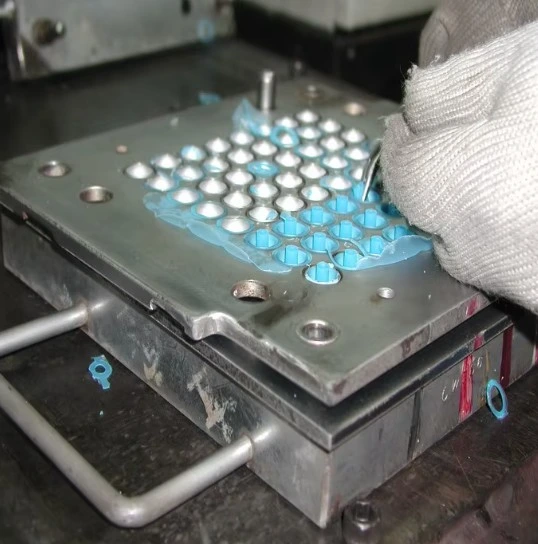
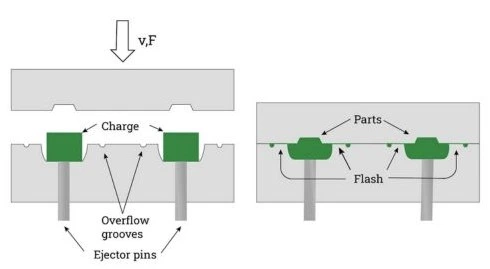
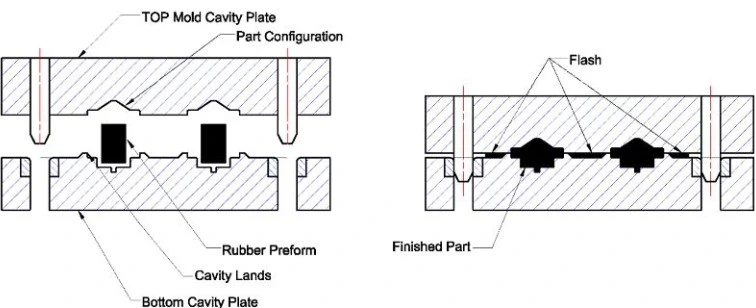
Compression molding is one of the oldest and most direct plastic-forming processes. A charge of material (preform, sheet, compound) is placed in a heated open mold. The mold closes under pressure - the material is compressed and takes exactly the shape of the cavity. It cures (thermosets, elastomers) or cools (thermoplastics) before opening and ejection.
This process is especially suited to materials that cannot withstand conventional injection: elastomers that vulcanize with heat, sheet composites (SMC), thermosets in powder or granule form. It's also the most economical process for small and medium runs of large parts.
This process is particularly suited to materials that cannot withstand conventional injection: elastomers that vulcanize with heat, sheet composites (SMC), thermosets in powder or granules. It is also the most economical process for small and medium runs of large parts.
CadNov is not a compression processor. We are your design office and integrator: we qualify your need, choose the right technology (compression, transfer, rubber injection), select the material and grade, coordinate the toolmaker and steer the trials through to validation.
CadNov is not a compression molder. We are your design office and integrator: we qualify your need, choose the right technology (compression, transfer, rubber injection), select the material and grade, coordinate the toolmaker and run the trials through to validation.
Our expertise covers the 4 major compression material families - rubbers, thermosets, SMC/BMC composites and thick thermoplastics. We can tell you when compression is the right choice and when another technology would be more effective.
⬇
🔒
🌡
⬆
4 material families for compression molding
Each family has its properties, its processing constraints and its areas of excellence. The right choice determines everything.
FAMILY 01 - Rubbers and Elastomers
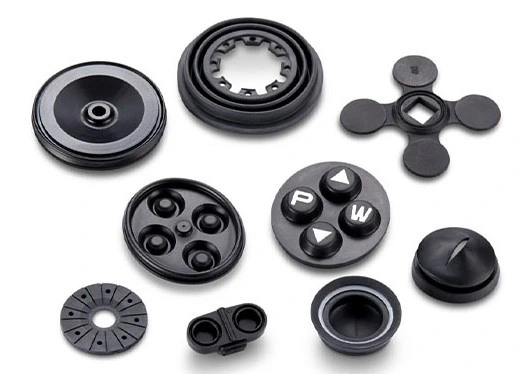
This is the historic area of excellence of compression molding. Hot vulcanization turns raw rubber into a cross-linked elastomer with definitive mechanical properties.
- EPDM - weather, UV, ozone resistance. Automotive and building seals. -40 to +150°C
- NBR (Nitrile) - oil and fuel resistance. Hydraulic seals, under-hood automotive. -30 to +120°C
- FKM / Viton - extreme chemical and thermal resistance. Oil, chemicals, aerospace. -20 to +220°C
- VMQ (Silicone) - food, medical, extreme temperatures. -60 to +220°C
- NR (Natural rubber) - vibration damping, flexibility. Silent-blocks, anti-vibration mounts
- SBR - economical, versatile. Soles, common industrial parts
- CR (Neoprene) - flame and weather resistance. Sealing joints
- HNBR - under-hood automotive, oil resistance at high temperature
Thermosets harden permanently with heat through an irreversible chemical reaction - they no longer melt afterwards. Ideal for parts that must permanently withstand high temperatures.
- Bakelite (phenol-formaldehyde) - the historical thermoset. Rigidity, thermal resistance, electrical insulation. Handles, electrical plugs
- Filled phenolic - thermal resistance up to 200°C, very good electrical insulation
- Melamine-formaldehyde - hard surface, resistance to scratches and chemicals. Tableware, laminates
- Thermoset polyester (UP) - the base of SMC/BMC composites
- Filled epoxy - excellent mechanical and chemical properties, electronics
- DAP (Diallyl phthalate) - high-frequency electronics, precise connectors
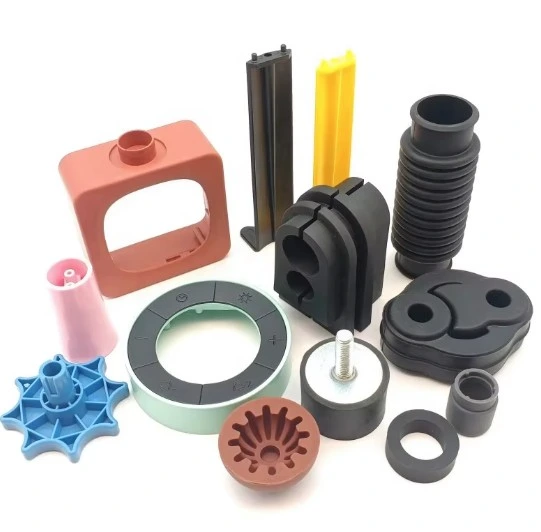
Compression-molded composites combine a thermoset resin with reinforcing fibers (glass, carbon, natural). Light, rigid, strong parts impossible to obtain by conventional plastic injection.
- SMC (Sheet Molding Compound) - polyester resin sheet + short glass fibers. Hoods, tailgates, body panels. Suppliers: IDI Composites, Polynt, Continental Structural Plastics
- BMC (Bulk Molding Compound) - bulk or billet compound. Electrical and technical parts. Suppliers: Polynt, IDI, Sumitomo Bakelite
- Carbon composites (CFRP) - maximum rigidity and lightness. Aerospace, motorsport
- Glass composites (GFRP) - favorable performance/cost ratio. Marine, transport, infrastructure
- Natural-fiber composites - flax, hemp, jute. Eco-design, automotive interiors
Compression molding of thermoplastics is less common than injection, but remains relevant in specific cases where injection reaches its limits: very high thicknesses, hard-to-inject materials, small runs.
- PTFE (Teflon) - cannot be injection molded. Compression + sintering is the only process. High-performance seals, chemicals
- UHMWPE - ultra-high-molecular-weight polyethylene. Wear plates, tribology parts
- PEEK - can be compressed for thick parts or small runs
- Thick PP / PE - massive parts hard to inject without sink marks
Caution: thermoplastic compression generates very long cycles and lower dimensional accuracy than injection. It's only justified when the other processes are impossible.
Simple compression is not the only option. Two variants - transfer and rubber injection - achieve higher precision and automation.
01 - Direct compression
Main limitation: the charge must be precisely weighed and positioned - risk of defects if poorly loaded (air inclusions, lack of material).
Pressure: 5 - 50 MPa · Tooling: simple 2-part mold · Applications: seals, flat parts, SMC panels
The charge is placed in a separate transfer pot. A piston pushes the hot material into the closed cavity through channels. Halfway between compression and injection.
Major advantage: the cavity is closed before filling - better dimensional accuracy, zero flash on inserts, the ability to integrate fragile metal inserts.
Rubber is injected into a closed mold under pressure, like plastic injection. A fully automatable process, high output, no manual loading operation.
Two sub-technologies: HCR (high-consistency rubber, injected hot) and LSR/LIM (liquid silicone, cold runner, zero waste).
Compression vs Plastic injection: choosing the right process
Compression is not an outdated process - it's the process suited to materials and configurations that injection cannot handle.
| Criterion | Compression | Transfer | Rubber injection | Plastic injection |
|---|---|---|---|---|
| Tooling | Very simple, economical | Moderate | Complex (= injection) | Complex and costly |
| Accuracy | +/-0.3 - 1 mm | +/-0.2 - 0.5 mm | +/-0.1 - 0.3 mm | +/-0.05 - 0.2 mm |
| Cycle | 2 - 15 min | 2 - 10 min | 30 s - 3 min | 10 - 120 s |
| Automation | Partial | Partial | Full possible | Full |
| Compatible materials | Elastomers, TS, composites, PTFE | Elastomers, TS | Rubbers, LSR | Thermoplastics only |
| Complex geometries | Limited | Medium | Good | Excellent |
| Optimal volume | 100 - 100,000/yr | 500 - 500,000/yr | 1,000 - M/yr | 1,000 - several M/yr |
| Thermosets | Yes | Yes | No | No |
Material choice is the most important decision. Here are the most-used compression materials sorted by function.
Material
| Family | Main function | Typical applications | Service T | Process | Process |
|---|---|---|---|---|---|
| EPDM | Elastomer | Sealing, UV/ozone/weather resistance | Automotive seals, building, sealing profiles | -40 to +150°C | Compression / Transfer |
| NBR | Elastomer | Oil and fuel resistance | Hydraulic seals, under-hood automotive, O-rings | -30 to +120°C | Compression / Injection |
| FKM / Viton | Extreme chemical and thermal resistance | Oil, chemicals, aerospace, agrochemicals | -20 to +220°C | -20 to +220 °C | Compression / Transfer |
| VMQ (Silicone) | Extreme chemical and thermal resistance | Food, medical, extreme temperatures | Food seals, teats, medical parts | -60 to +220°C | Compression / LIM (LSR) |
| NR (Natural) | Extreme chemical and thermal resistance | Vibration damping, flexibility | Silent-blocks, anti-vibration mounts, soles | -50 to +80°C | Compression |
| CR (Neoprene) | Extreme chemical and thermal resistance | Flame and weather resistance | Sealing joints, wetsuits, insulators | -40 to +120°C | Compression |
| Bakelite (PF) | Thermoset | Electrical insulation, permanent thermal resistance | Plugs, handles, electrical equipment | Up to 200°C | Direct compression |
| Melamine (MF) | Thermoset | Hard surface, scratch resistance | Tableware, laminates, coatings | Up to 130°C | Direct compression |
| Filled epoxy | Thermoset | Excellent mechanical + chemical properties | Electronics, structural bonding, composites | Up to 180°C | Transfer / Compression |
| SMC | Composite | Lightness + rigidity on large surfaces | Car hoods, tailgates, body panels | Up to 150°C | SMC compression |
| BMC | Composite | Precision + electrical and thermal resistance | Electrical parts, housings, technical parts | Up to 150°C | Compression / Transfer BMC |
| CFRP (carbon) | Composite | Maximum rigidity + lightness | Aerospace, motorsport, high-level sport | Varies by resin | Compression / autoclave |
| PTFE | Special thermoplastic | Universal chemical resistance, low friction | Chemical seals, tribology parts, electronics | -200 to +260°C | Compression + sintering |
Fields of application
Compression covers applications that injection simply cannot handle - from elastomer seals to composite body panels.
Automotive and Transport
Engine and body sealing joints (EPDM), anti-vibration mounts (NR), SMC hoods and tailgates for weight reduction. IATF 16949 standard required for tier suppliers.
Electrical and Electronics
Insulating parts in bakelite or phenolic, BMC electrical housings, component encapsulation in epoxy resin. Permanent thermal and electrical insulation.
Chemicals and Oil
FKM/Viton seals for resistance to solvents, acids and high temperatures. PTFE seals for universal chemistry. UHMWPE tribology parts.
Medical and Food
Biocompatible VMQ silicone seals (ISO 10993, FDA), teats, membranes, LSR medical parts. Material traceability and batch certification mandatory.
Aerospace and Defense
Carbon composite parts for structural weight reduction, high-temperature FKM seals, PTFE parts for extreme chemical resistance. Strict material qualification files.
Construction and Infrastructure
EPDM sealing profiles and joints for joinery, NR vibration mounts for railways and buildings, thermal and acoustic insulation parts.
Our compression approach
From your need to the production part - CadNov steers every step and saves you from costly mistakes.
Needs analysis
Material, function, standards, volume, lead time
Process choice
Compression / Transfer / Rubber injection
Material choice
Exact grade, formulator, technical sheet
Tooling
Specifications, processor selection
Trials and production
Part qualification, inspection plan
MISTAKE 01
If the volume exceeds 20,000 parts/year and the part allows it, rubber injection is often more economical over time despite more expensive tooling up front.
MISTAKE 02
A seal that is too hard does not compensate for surface defects. A seal that is too soft extrudes under pressure. The Shore hardness must be calculated according to the application pressure.
MISTAKE 03
An NBR degrades in modern E10+ fuels. An EPDM swells in oils. Chemical compatibility must be checked on the exact formulation, not on the general family.
Innovation Tax Credit (CII)
CadNov is approved by the French Ministry (MESR). The costs of design, material formulation and compression molding trials within an innovative project are eligible for the CII - up to 30% recovered.
CadNov is approved by the French Ministry (MESR). The costs of design, material formulation and compression molding trials within an innovative project are eligible for the CII tax credit — up to 30% recovered.
A compression molding project? Let's talk.
Free feasibility analysis within 48h - material, process, volume, indicative budget.
Submit my projectSee plastic injection moldingAntoine ERRIGO · +33 (0)4 74 32 23 60 · direction@cadnov.fr · CadNov, 240 rue des Câbles de Lyon, 01000 Saint Denis Lès Bourg · CII-approved