Vacuum casting:
two-material, unlimited colors,
shapes without constraints
Vacuum casting (silicone duplication) produces PU resin parts in 6 to 12 days - soft parts from 30 to 90 Shore A, transparent, two-material like an overmolded injection, in any color and without shape constraints. CadNov is CII-approved.
What is vacuum casting?
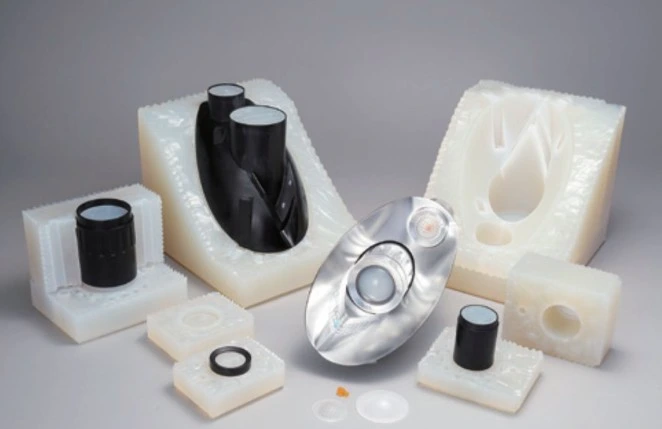
Vacuum casting - or silicone duplication - means creating a soft silicone mold from a master pattern (machined or 3D printed), then casting a polyurethane (PU) resin into it under vacuum to obtain faithful copies of the pattern.
The vacuum removes air bubbles during casting - the part has no visible porosity. Each silicone mold produces 15 to 20 parts. It's the ideal process for runs of 5 to 50 parts: low cost, short lead time, total design freedom - undercuts, two-material, custom colors, soft parts - everything is possible.
What CadNov brings:
CadNov coordinates the whole process: making the master pattern, producing the silicone mold, selecting the right PU resin, vacuum casting and finishing.
Our material expertise is decisive: choosing the right PU grade (Shore hardness, color, thermal resistance, transparency, two-material compatibility) requires precise knowledge of the formulators. CadNov works with proven PU ranges for a reproducible result.
4 unique capabilities of vacuum casting
That conventional plastic injection cannot offer - or only at a prohibitive cost
Unlimited colors
Any RAL or Pantone color. Tint integrated into the mass - not a paint that flakes off.
Overmolded two-material
Rigid + soft in the same part. Like injection overmolding - without a costly mold.
Small undercuts
The silicone flexes during demolding. Grooves, small recessed shapes without a costly slide.
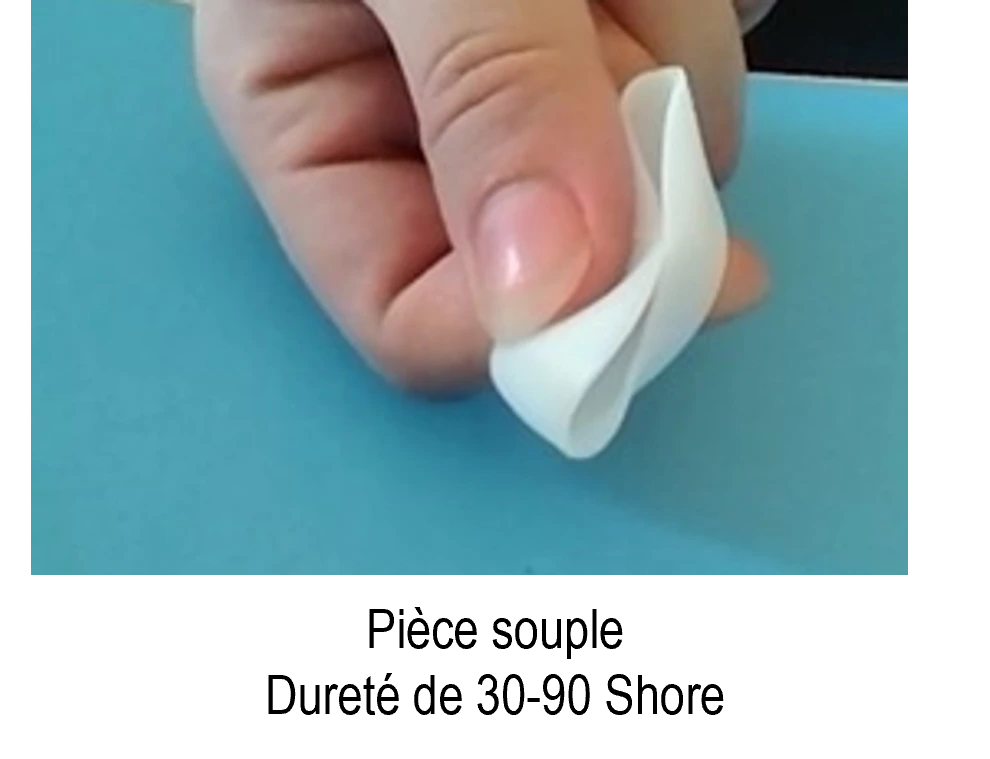
Soft 30-90 Shore A
From compressible foam to rigid sole. The only technology for soft prototypes in small runs.
The duplication process - 6 steps
From the 3D file to the PU resin part - CadNov masters every step of the silicone duplication cycle.
Pattern preparation
The master pattern is CNC machined or printed in high-resolution SLA. It must be perfect: every defect will be reproduced on all parts. Finishing and painting if needed.
Pattern = indirect moldPositioning in a casing
The pattern is suspended in a casing. The injection and vent points are defined. The parting line is drawn - small undercuts and two-material zones are anticipated at this stage.
Undercuts anticipatedSilicone casting
Two-component liquid silicone is poured into the casing, embedding the pattern. Vacuum degassing to remove bubbles. Oven curing 8 to 16h for polymerization.
Soft RTV siliconeCutting the silicone mold
After polymerization, the silicone mold is cut along the parting line. The pattern is removed. The mold is ready - it will reproduce every shape, including small undercuts.
Ready-to-use moldVacuum PU casting + oven curing
Two-component PU resin mixed with the chosen tint, then vacuum cast into the closed mold. For two-material: casting in 2 successive stages. Oven curing 2 to 4h at 70°C.
Tint integrated into the massDemolding and finishing
The soft silicone mold opens by flexing - even on shapes with small undercuts. The part is cleanly removed. Paint or chrome finishing available.
Small undercuts demolded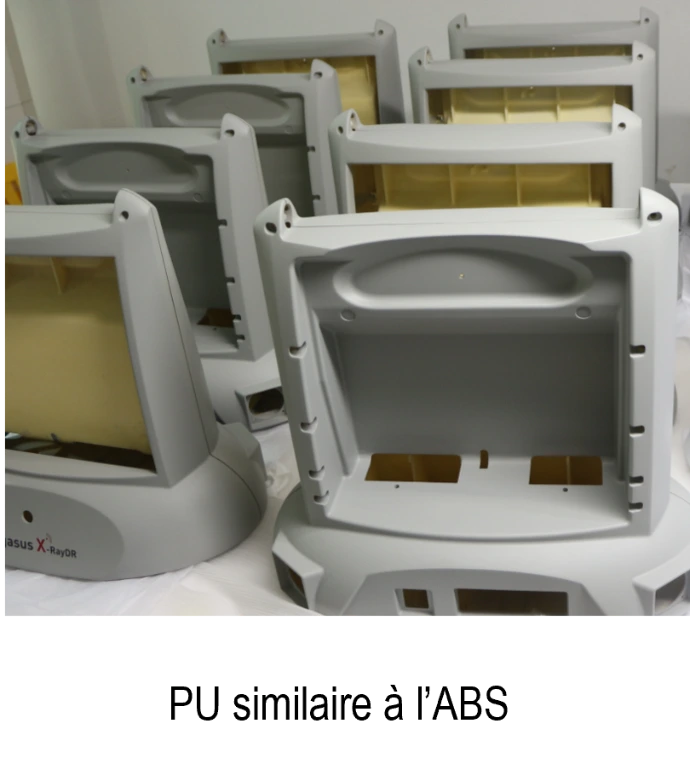
Two-material: rigid + soft in the same part
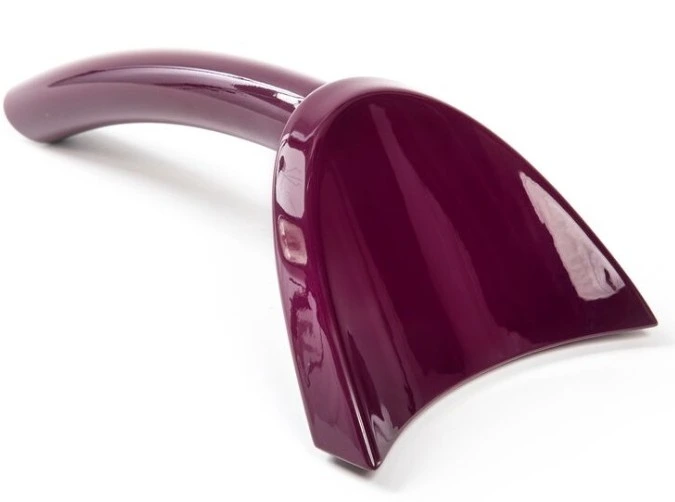
Vacuum casting can simulate the two-material overmolding of plastic injection - without complex tooling and in a few days.
In plastic injection, two-material (or overmolding) requires a rotary press and two separate molds - an investment of 40,000 to 200,000 euros. In vacuum casting, the same two-material part is made in two successive castings in the same silicone mold: the first rigid resin is cast and cured, then the second soft resin is cast on top - the two materials bond chemically.
The result is a functional, attractive two-material part, with a rigid/soft bond as strong as in injection. Ideal to validate the look, test ergonomics and present the product before committing to tooling.
Concrete example: two-material handle
A tool or electronic device handle: rigid body (ABS-like PU) with a soft grip section (PU Shore A 40-55). The same result as an overmolded injected part - delivered in 6 to 10 days, for 5 to 20 units.
Two-material process in 4 steps
Casting 1
Rigid ABS-like PU in the silicone mold
Polymerization
Oven curing - the rigid body hardens fully
Casting 2
Soft PU Shore A 40-55 on the rigid substrate
Demolding
Two-material part chemically bonded
Typical two-material applications
Handles and tools
Rigid body (ABS-like PU) + soft grip zone (PU Shore A 40-60). Ergonomics tested in real conditions before two-material injection tooling.
Rigid + soft bodyHousings with integrated seal
Enclosure shell (ABS-like PU) with a soft PU sealing gasket molded directly into the groove. Eliminates seal assembly - like two-material injection.
Direct integrated sealConsumer products
Remote controls, controllers, electronic devices, sports accessories - soft non-slip zone on a rigid structure. Client presentation before launch.
Client presentation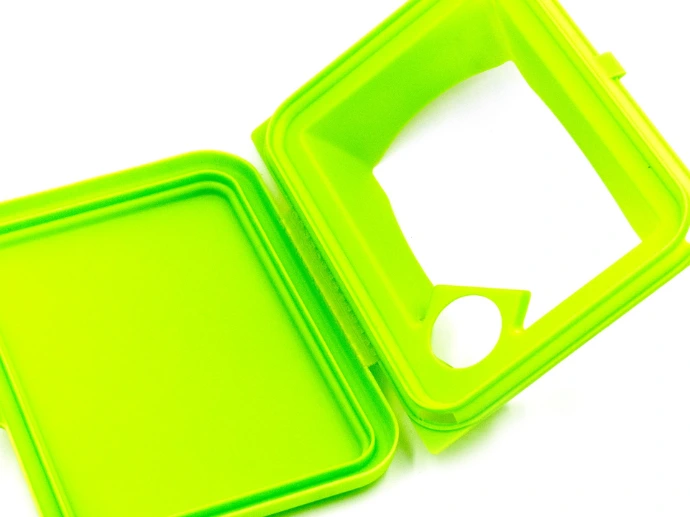
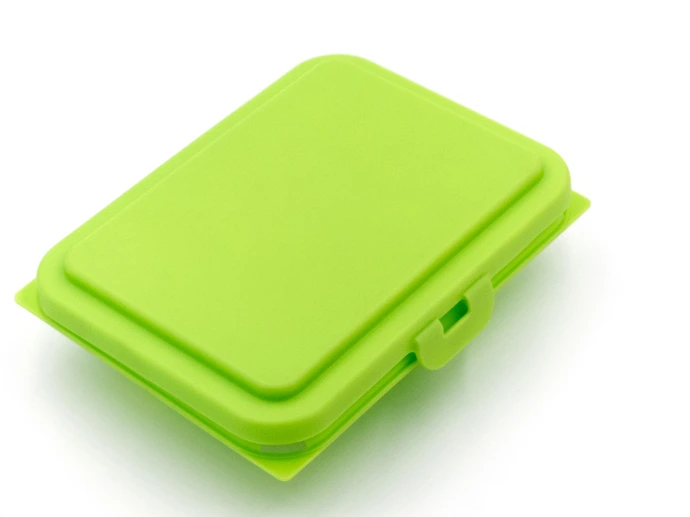
Unlimited colors and shapes without constraints
Two freedoms that plastic injection does not offer easily - and that make all the difference at the prototype stage.
Unlimited colors - integrated into the mass
CP pigments are mixed directly into the PU resin before casting - the color is in the mass of the part, not on the surface. Result: a uniform tint, with no flaking risk, identical on every part of the run.
Any RAL or Pantone reference can be reproduced. Several different colors within the same run at no extra tooling cost - just a pigment change.
+ any RAL, Pantone reference or supplied sample
Small undercuts: no constraint
In plastic injection, an undercut (groove, overhang, recessed angle) requires a slide in the mold - a mechanism that can cost 5,000 to 30,000 euros more.
In vacuum casting, the silicone mold is soft. It flexes during demolding to release the part even with small undercuts. Grooves, small threads, pins, slightly recessed shapes - directly reproducible without complex tooling.
This freedom allows prototyping parts that would be costly to inject - and validating the design before investing in that tooling.
The winning combination
CadNov can produce a two-material part (rigid + soft), in the exact desired color, with small integrated undercuts - all in a single silicone mold. A level of freedom unique at this price and in these lead times.
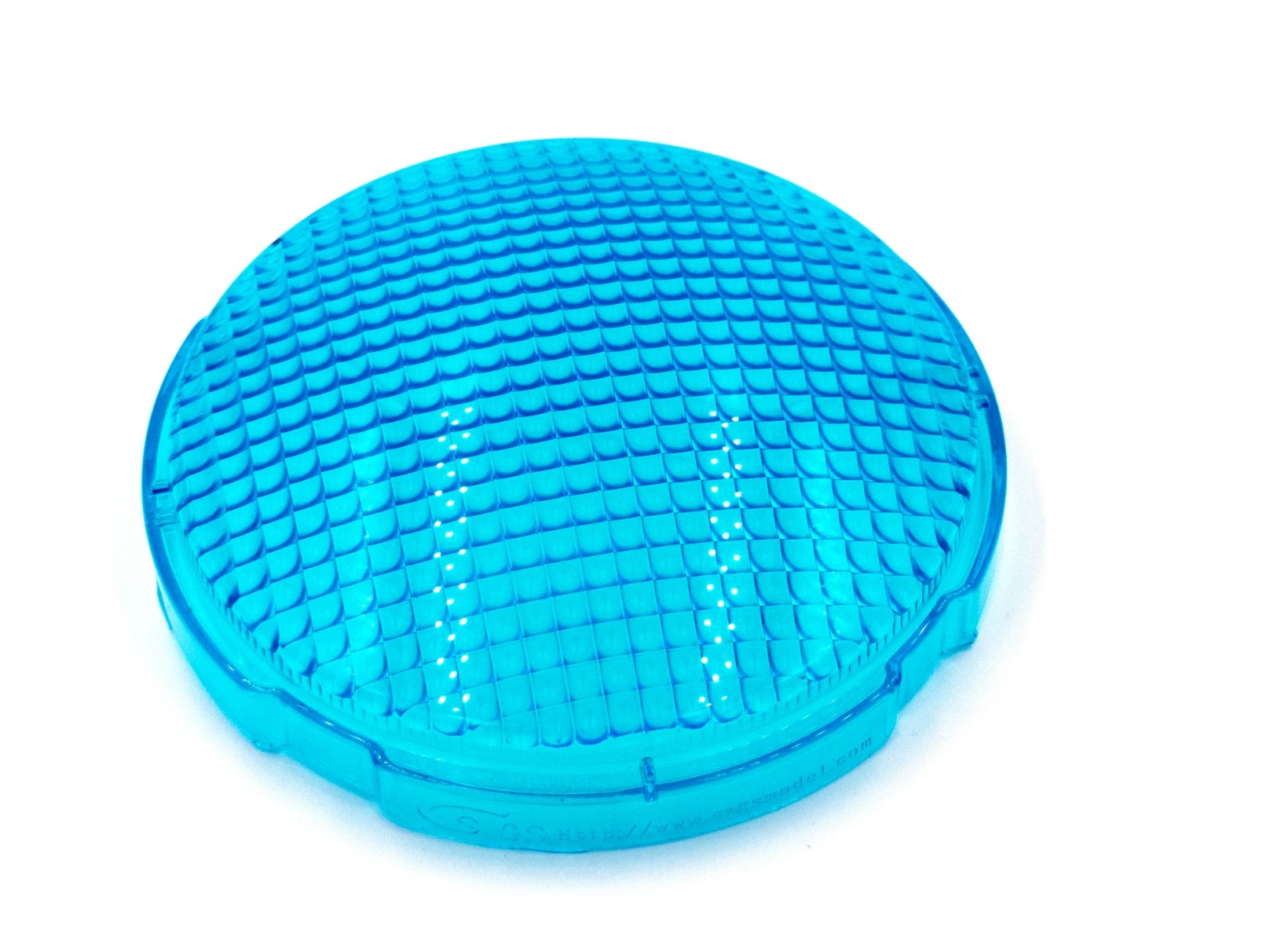
Special PU materials: transparent and soft Shore A
In addition to two-material and colors, two PU families enable applications that no other prototyping process covers as well.
Transparent PU - similar to PMMA / PC
Transparent PU resins (UPX 5210, PX520, Z1940) produce parts with good transparency, visually close to PMMA or PC. Ideal to validate optics, backlighting effects or the look of a product before committing to a mirror-polished mold.
Decisive advantage: transparent PU can be cast into shapes with small undercuts - impossible to produce in machined PMMA or PC without multiple, costly operations.
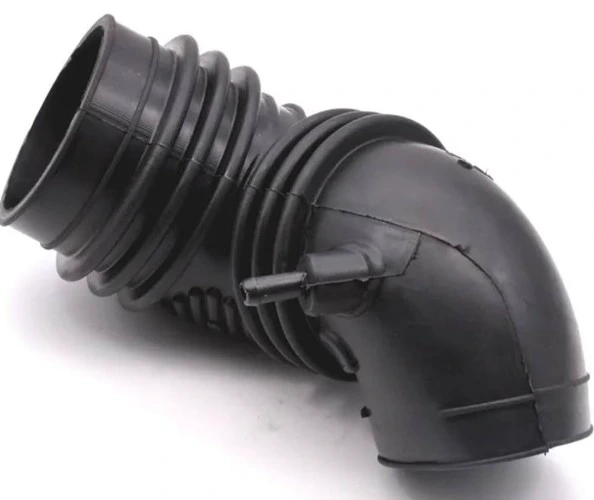
Soft PU - 30 to 90 Shore A
Soft PU resins (Hei-Cast 8400, MU-89, T0387) produce elastic parts whose hardness is set between 30 and 90 Shore A - from soft foam to rigid sole. It's the only prototyping process able to produce genuine soft parts in small runs.
These resins are used for the soft parts of two-material: cast onto the already-cured rigid substrate, they bond chemically - exactly like injection overmolding.
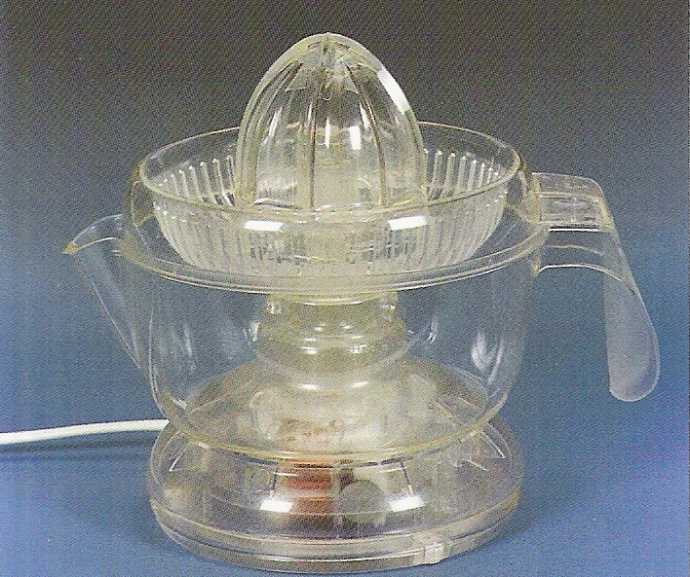
Available PU resins - families and grades
Each PU grade is formulated to reproduce the behavior of a specific thermoplastic. CadNov selects the exact grade - and combines them for two-material.
ABS-like PU - rigid, resistant, paintable
| Reference | Shore D | Deflection T | Characteristics |
|---|---|---|---|
| Hei-Cast 8150 | 80-85 D | 100°C | Balanced properties, easy to process. Standard ABS type. Ideal base for two-material. |
| PX-223 | 65-80 D | 120°C | Impact resistance, flame resistance. High temperature. |
| UP 6160 | 80-81 D | 190°C | Good thermal resistance. High-temperature grade. |
| Hei-Cast 8263 | 83 D | 80°C | Balanced properties, flame-retardant, UL94-V0. |
Transparent PU - similar to PMMA / PC
| Reference | Shore D | Deflection T | Characteristics |
|---|---|---|---|
| PX520 | 82 D | 70°C | Good transparency, low shrinkage. |
| UPX 5210 | 83 D | 70-90°C | Good transparency with UV resistance. |
| Z1940 | 82 D | 75°C | Transparency + UV resistance + yellowing resistance. |
Soft PU - Rubber-like - 20 to 90 Shore A (used for two-material)
| Reference | Color | Shore A | Characteristics |
|---|---|---|---|
| Hei-Cast 8400 | Variable | 30-90 A | Variable hardness, CP pigmentable. Chemically bonds to rigid PUs for two-material. |
| MU-89 | Variable | 20-90 A | Variable hardness, CP pigmentable. Two-material compatible. |
| T0387 | Transparent | 30-80 A | Soft transparent version available. |
PU similar to PP, POM, PA
| Reference | Similar to | Shore D | Deflection T | Characteristics |
|---|---|---|---|---|
| UP 5690 | PP-like | 75-83 D | - | Adjustable flexural modulus, high impact resistance, unbreakable. |
| XU-50 | POM-like | 87 D | 145°C | High reproduction accuracy, high flexural modulus. |
| 2180 | PA-like | 87 D | 135°C | Very low shrinkage (0.2%), corrosion and abrasion resistance. |
PU selection for two-material: how CadNov chooses
For a two-material part, CadNov selects two chemically compatible grades - a rigid PU for the body (ABS-like, PA-like, POM-like) and a soft PU for the overmolded section (Rubber-like Shore A suited to your need). The chemical bond between the two resins is checked before production. Result: strong adhesion, with no risk of separation.
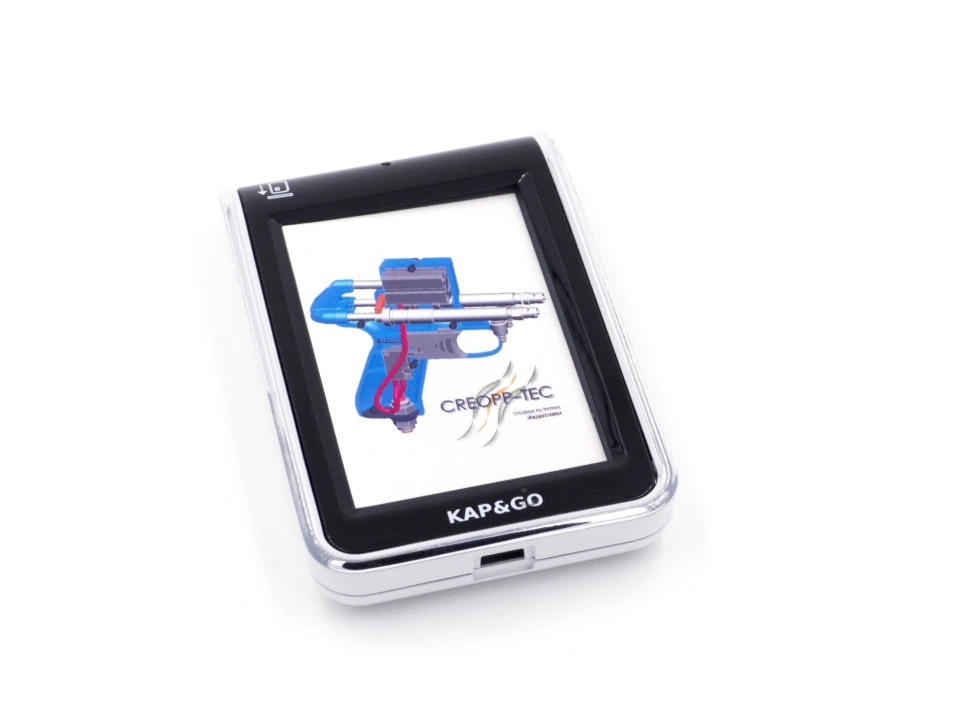
Advantages and limits of vacuum casting
A powerful, flexible process - with specific constraints to factor into your schedule.
Advantages
Two-material without complex tooling
A single silicone mold to produce a rigid + soft overmolded part - like two-material injection, but without the 40,000 to 200,000 euros of rotary press and double mold.
Unlimited colors in the mass
Any RAL or Pantone color, integrated into the resin - not a surface paint. Several different colors within the same run at no extra tooling cost.
Small undercuts without constraint
The soft silicone mold flexes during demolding. Grooves, small threads, light overhangs - shapes that are hard or costly to inject without slides.
Soft parts impossible otherwise
The only process allowing Shore A 30 to 90 parts in small runs with complex geometries. Machining does not produce elastic parts.
Very good surface finish
The silicone faithfully reproduces the pattern's surface finish - texture, grain, gloss. Compatible with painting and chrome plating after casting.
Affordable price - short lead time
Silicone mold 500 to 2,000 euros. Lead time 6 to 12 days. Ideal for 5 to 20 validation or presentation parts.
Limitations
Mold life limited to 20 parts
The silicone degrades after 15 to 25 castings. Beyond 20 identical parts, a new mold is needed - or a switch to an aluminum prototype mold.
PU resin is not the production material
Even an ABS-like PU is still PU, not ABS. For critical mechanical or chemical tests, machining in the real material remains essential.
Delivery time to anticipate
6 to 12 days of manufacturing + delivery time. On projects with a tight schedule, plan ahead.
Lower accuracy than machining
PU shrinkage during polymerization: +/-0.1 to +/-0.3%. For parts with very tight dimensional tolerances, machining remains superior.
Large undercuts impossible
The silicone handles small undercuts, not large deep grooves or heavily recessed shapes. To be assessed case by case with CadNov.
Applications and fields
Vacuum casting is used whenever a small run of functional, attractive or two-material parts is needed quickly.
Functional validation
Prototypes for mechanical, assembly and snap-fit tests. Rigid PUs (ABS-like, PA-like) for parts under stress. Two-material to validate ergonomics.
Presentation and Marketing
Client presentation models in the final color, colored exhibition prototypes. Paint and chrome finishing available. Very high visual quality.
Ergonomics and Consumer
Two-material handles (rigid + soft), electronic devices, controllers, remote controls with soft grip zones. Final design validation before launch.
Optics and Transparency
Transparent parts for optical validation, backlighting, glazing with small undercuts. Transparent PU (PX520, Z1940) with UV resistance.
Medical and Paramedical
Medical device shells (colored ABS-like PU), soft parts for devices (soft Shore A PU), two-material anatomical models for training.
Complex parts
All parts with small undercuts, internal grooves, small threads - hard to inject without complex tooling. Vacuum casting produces them directly.
Our vacuum casting approach
From your 3D file to the delivered run - CadNov steers every step.
Machined or SLA
Finished master pattern + two-material parting line and undercuts if required
Casting + oven curing
Silicone mold in 24-48h, small undercuts and two-material zones anticipated
Vacuum PU casting
1 or 2 castings (two-material), chosen tint, finishing if required, delivery
Indicative quantities and lead times
1 silicone mold: 15 to 20 parts. Mold lead time: 3 to 5 days. Run of 10 parts: 3 to 7 additional days. Two-material: +1 to 2 days for the second casting. Total first run: 6 to 12 days.
What you get
Parts very close to the final product
Close material, exact color, functional two-material, small undercuts reproduced - the CadNov prototype is 90% representative of the production product.
Batch-to-batch reproducibility
Each part produced with the same mold, the same PU grade and the same pigment is identical to +/-0.2%. Ideal for assembly tests and client presentations.
CII - up to 30% recovered
CadNov is approved by the French Ministry (MESR). Vacuum casting costs within an innovative project are eligible for the CII. File support included.
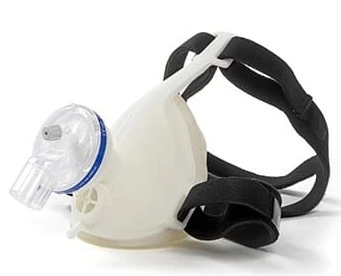
A vacuum casting project? Quote in 24h.
Send your 3D file, your material, color and quantity requirements. Answer within 24h.
Request a quoteSee CNC plastic machiningAntoine ERRIGO · +33 (0)4 74 32 23 60 · direction@cadnov.fr · CadNov, 240 rue des Câbles de Lyon, 01000 Saint Denis Lès Bourg · CII-approved