RIM - Reaction Injection Molding:
large parts, small and medium runs
without the investment of a steel mold
RIM (Reaction Injection Molding) produces polyurethane parts in resin or aluminum molds - large dimensions, overmolded two-material, undercuts with slides, rigid or soft parts. The intermediate process between vacuum casting and plastic injection. CadNov is CII-approved.
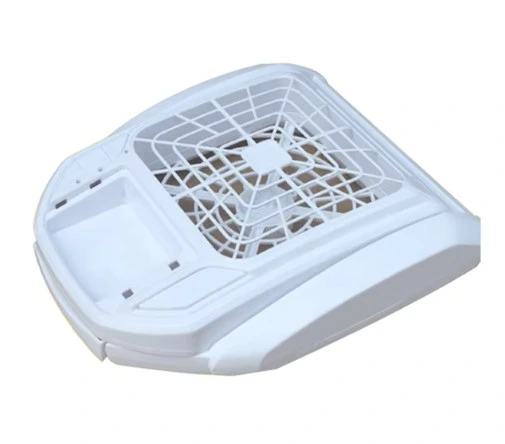
RIM: when vacuum casting is no longer enough
RIM (Reaction Injection Molding) is a polyurethane processing method: two liquid components (polyol + isocyanate) are mixed at high pressure, injected into a closed mold, then react chemically to form a solid part - rigid, soft or structural foam depending on the formulation.
The fundamental difference from vacuum casting: the molds are not silicone, but epoxy resin, aluminum or light steel. These more rigid molds allow better dimensional accuracy, longer runs (50 to 1,000 parts and more), and undercuts made with slides built into the mold - exactly like plastic injection.
RIM is especially suited to large parts that plastic injection cannot produce without a very costly steel mold: medical equipment covers, electric vehicle bodywork, heavy-truck dashboards, industrial equipment casings.
RIM vs Vacuum casting
Both processes use PU resins, but address very different needs. The right choice depends on volume, dimension and required accuracy.
Direct comparison
Vacuum casting
Soft silicone mold - 15 to 20 parts max per mold
Small parts (under 500 mm)
Small undercuts only
Mold cost: 500 - 2,000 euros
Lead time: 6-12 days
RIM
Resin or aluminum mold - 50 to 1,000+ parts per mold
Large parts (up to 2 m and more)
Slides = complex undercuts
Mold cost: 3,000 - 30,000 euros
Lead time: 3 to 6 weeks (mold + 1st part)
CadNov chooses for you
Vacuum casting for 5 to 20 parts or urgent lead time. RIM for 50 to 1,000 parts, large dimensions, or complex undercuts requiring slides. Plastic injection beyond that. CadNov tells you the optimal process according to your volume and budget.
The RIM process - from CAD to part
RIM combines the versatility of PU materials with the precision of rigid molds - a more industrial process than vacuum casting, but far more economical than steel plastic injection.
Mold manufacturing
Mold in filled epoxy resin (prototype/pre-production) or machined aluminum (pre-production/production). Built-in slides if undercuts. Thermal regulation circuits.
Preparation and closing
Application of release agent. Insertion of any inserts (metal, reinforcements). Closing and locking the mold under pressure. Slides in position.
PU reaction injection
Polyol and isocyanate mixed in a mixing head at high pressure (100-200 bar), injected into the mold within seconds. The exothermic reaction heats and solidifies the part.
Demolding and finishing
Cycle time 3 to 15 min depending on thickness. Slides withdrawn, mold opened, part removed. Deburring, sanding, primer, paint - finishing required for a finished surface.
3 types of RIM molds by volume
Epoxy resin mold
Made by casting over a pattern or CNC machining of filled resin. Very accessible cost. Lasts 50 to 200 parts depending on use conditions.
Lead time: 2 to 4 weeks
Cost: 3,000 - 10,000 euros
Run: 50 - 200 parts
Aluminum mold
Machined in 7075 aluminum. Higher accuracy than resin, quality surface, life up to 1,000 - 5,000 parts. Complex slides possible. Standard for pre-production and small runs.
Lead time: 3 to 6 weeks
Cost: 10,000 - 30,000 euros
Run: 200 - 1,000+ parts
Light steel mold
For larger volumes or very high-precision parts. Life over 5,000 parts. Same principle as a plastic injection mold - but much lower injection pressure.
Lead time: 6 to 10 weeks
Cost: 20,000 - 80,000 euros
Run: 1,000 - 5,000+ parts
RIM's major asset: large parts
RIM is often the only economical solution for large parts - where plastic injection requires a steel mold of 100,000 to 500,000 euros.
PU reacts at low pressure (5 to 30 bar) compared to plastic injection (500 to 1,500 bar). This low pressure allows resin or aluminum molds - and filling very large cavities without stress on the tooling.
Parts of 1 to 2 meters, or several kilos, can be made in RIM with a reasonable mold investment. It's the reference process for large presentation parts, equipment covers and industrial casings in small and medium runs.
Concrete example: medical scanner cover
A medical scanner cover typically measures 1,200 x 600 x 400 mm, with complex curved shapes, lateral undercuts (slides) and a required RAL 9003 white paint finish. In plastic injection: steel mold over 200,000 euros. In RIM with an aluminum mold: 15,000 - 25,000 euros. For a run of 100 to 500 parts, RIM is the only economically viable option.
Undercuts with slides - like plastic injection
RIM resin or aluminum molds can incorporate mechanical slides - exactly like a plastic injection mold. This allows demolding complex undercuts, deep grooves, ventilation louvers and integrated clips with no constraint. A decisive advantage over vacuum casting (limited to small undercuts only).

Two-material and overmolding - like plastic injection
RIM allows two-material overmolding with the same logic as plastic injection - rigid + soft in the same part, without dual-press tooling.
Two-material overmolding in RIM is done in two successive injections in the same mold or in two complementary molds: the first injection produces the rigid substrate (rigid PU Shore D 60-80), the second injects the soft PU (Shore A 30-80) on top. The two materials bond chemically - same principle as 2K injection.
Compared to two-material vacuum casting, two-material RIM offers higher dimensional accuracy, better cycle-to-cycle repeatability, and addresses longer runs (100 to 1,000 parts).
Two-material RIM - process
Rigid body + soft zone in the same RIM part - for ergonomic handles, housings with a soft grip zone, panels with elastomer inserts.
Mold closed
Rigid PU substrate injection
Polymerization
Rigid substrate cured (3-8 min)
2nd injection
Soft PU Shore A on substrate
Demolding
Permanent chemical adhesion
Medical equipment
Rigid shell + integrated soft handle. One-piece part without assembly. Paint finish.
Two-material RIMFurniture and home
Rigid armrest + soft seat, door panel with integrated soft-touch zone.
Two-material RIM
PU materials available in RIM
RIM uses the same PU resin families as vacuum casting - but with a formulation suited to pressure injection and repeated cycles.
Rigid PU - similar to ABS / PP
The most used formulation in RIM. Produces rigid parts with good impact resistance, compatible with paint and surface finishes. Forms the rigid substrate of two-material parts.
Soft PU - 30 to 90 Shore A
Elastic parts whose hardness is adjusted by formulation. Used for the soft parts of two-material (handles, soft-touch zones), but also for fully soft parts (seals, skins, bellows).
Structural foam PU - lightness + rigidity
Foaming formulation that produces a part with a rigid outer skin and a cellular core. The result: very light parts with excellent bending stiffness - essential for large thick-wall parts (covers, lids, casings). Up to 40% weight savings.
RRIM - glass-fiber reinforced PU
RRIM (Reinforced RIM) incorporates short glass fibers into the PU mix. Bending strength multiplied by 2 to 3, reduced thermal shrinkage, improved dimensional stability - for structural parts or those exposed to large temperature variations.
RIM PU materials summary by application
| RIM PU formulation | Hardness | T resistance | Typical application | Two-material |
|---|---|---|---|---|
| Rigid PU (ABS-like) | Shore D 65-80 | 80-120°C | Covers, casings, enclosure shells, panels | Rigid substrate |
| High-temperature rigid PU | Shore D 75-85 | 120-190°C | Under-hood parts, sterilizable medical | High-temperature substrate |
| Soft PU Shore A 30-50 | Shore A 30-50 | 70°C | Soft skins, soft-touch zones, bellows | Soft part |
| Soft PU Shore A 60-90 | Shore A 60-90 | 80°C | Semi-rigid seals, dampers, functional handles | Soft part |
| Structural foam PU | Shore D 40-60 (skin) | 80°C | Large light parts, medical covers, furniture | No |
| RRIM (PU + glass fibers) | Shore D 70-85 | 100-130°C | Bumpers, car fenders, structural parts | Reinforced substrate |
| Transparent PU (PC-like) | Shore D 78-85 | 60-90°C | Windows, translucent covers, optical parts | Transparent zone |
Advantages and limits of RIM - in full transparency
RIM is a powerful process for large parts in small and medium runs. Its limits are real and must be built into your schedule and budget.
Advantages
Large parts without a costly steel mold
The low injection pressure allows resin or aluminum molds - 5 to 20 times cheaper than a steel plastic-injection mold. The only economical solution for runs of 50 to 1,000 large parts.
Complex undercuts with slides
Rigid molds incorporate mechanical slides - exactly like plastic injection. Deep grooves, complex louvers, integrated clips: no geometric limit tied to demolding.
Functional overmolded two-material
Rigid + soft in the same part, with permanent chemical adhesion. Ergonomic handles, integrated seals, soft-touch zones - without assembly or bonding.
Soft parts 30 to 90 Shore A
Soft PU formulations available for grip zones, integrated seals, dashboard skins and anti-vibration elements.
Structural foam - lightness
Light parts with a rigid skin and cellular core. Up to 40% weight savings versus a solid PU part. Ideal for large covers.
Moderate mold cost
Resin mold: 3,000 - 10,000 euros. Aluminum mold: 10,000 - 30,000 euros. Well below an injection steel mold (80,000 - 500,000 euros) for the same dimensions.
Limitations
Raw parts - sanding and painting mandatory
RIM parts come out of the mold with a matte surface and visible micropores. They always require sanding, priming (surface primer) and a full paint job before they are presentable. These finishing operations represent 40 to 60% of the total cost of the finished part.
Finished part more expensive than plastic injection
The unit cost of a finished RIM part (with sanding + paint) is significantly higher than a series-injected part. RIM is economical for 50 to 1,000 parts - beyond that, plastic injection with a steel mold becomes more profitable.
Longer lead time than vacuum casting
Making the rigid mold (resin or aluminum) takes 3 to 6 weeks. If the deadline is critical (under 2 weeks), vacuum casting remains the best option for small parts.
PU resin different from the production material
RIM PU does not replace an injection ABS, PA or PC. For critical mechanical tests (impact, thermal fatigue, chemical compatibility), plastic injection in the real material remains necessary.
Slow cycle compared to injection
Cycle time 3 to 15 minutes depending on thickness and formulation - versus 30 to 120 seconds in plastic injection. RIM is not suited to production volumes beyond 1,000 - 2,000 parts per year.
Critical point to anticipate: the cost of paint
On a RIM part, the finishing cost (sanding + filler + primer + paint + inspection) often represents more than the cost of the raw part itself. CadNov systematically includes these costs in the total quote - to avoid unpleasant surprises at the end of the project.
Applications and fields
RIM is the reference technology for large parts in small and medium runs in high-value-added industries.
Medical and Paramedical
Scanner covers, MRI, radiology devices, rehabilitation equipment. Large dimensions, medical-white paint finish, hygiene requirements. Structural foam PU for lightness.
Automotive and Transport
Prototype bumpers, fenders, electric vehicle casings, heavy-truck dashboards, cabin trim. RRIM for structural parts. Two-material for soft-touch zones.
Industry and Machines
CNC machine casings, industrial equipment covers, conveyor covers, control-system enclosures. Rigid PU or structural foam depending on size.
Furniture and Public spaces
Seat cushions (foam PU), two-material armrests, urban furniture, acoustic partition panels. Complex design, organic shapes, paint or textile-covered finish.
Electronics and Telecom
Large enclosures for network equipment, distribution cabinets, server covers. Rigid PU with RAL-tinted paint finish. Slides for connectors and cabling.
Defense and Aerospace
Equipment bay covers, aircraft interior trim, radome covers. Reinforced RRIM for structural loads. Specific paint finishes (anti-UV, fuel resistance).
Our RIM approach
From your need to the prototype or the delivered run - CadNov steers the whole RIM process.
3D file + specifications
Volume, dimensions, material, finish, lead time - CadNov chooses resin, aluminum or steel mold
Mold manufacturing
Resin (2-4 wk) or aluminum (4-6 wk) - first trials + part validation with client
Run + paint
Series production, sanding, primer, paint, inspection, delivery
Full indicative lead times (mold + 1st finished part)
Resin mold + 1st painted part: 4 to 6 weeks. Aluminum mold + 1st painted part: 6 to 10 weeks. Second mold (same design): lead time reduced by 30%. Series production (from the 2nd batch) is much faster.
What CadNov guarantees
Complete quote including finishing
At CadNov, the RIM quote always includes the cost of sanding, priming and paint - not just the raw part. Zero surprises at the end of the project.
Validation before the run
A validation part is produced and presented before launching the run. Mold adjustments possible at this stage - changes stay economical on resin or aluminum.
CII - up to 30% recovered
CadNov is approved by the French Ministry (MESR). RIM costs within an innovative project are eligible for the CII. File support included.
A RIM project? Complete quote in 48h.
Send your 3D file, the dimensions, the target volume and the finishing requirements. CadNov replies within 48h with a complete quote: mold + parts + paint.
Request a quoteSee vacuum castingAntoine ERRIGO · +33 (0)4 74 32 23 60 · direction@cadnov.fr · CadNov, 240 rue des Câbles de Lyon, 01000 Saint Denis Lès Bourg · CII-approved