Thermoforming:
large parts, light tooling,
short lead times
Thermoforming is the ideal solution for large-dimension parts in small and medium runs - with tooling costs 10 to 50 times lower than plastic injection. Since 1996, CadNov steers your thermoforming projects from A to Z.
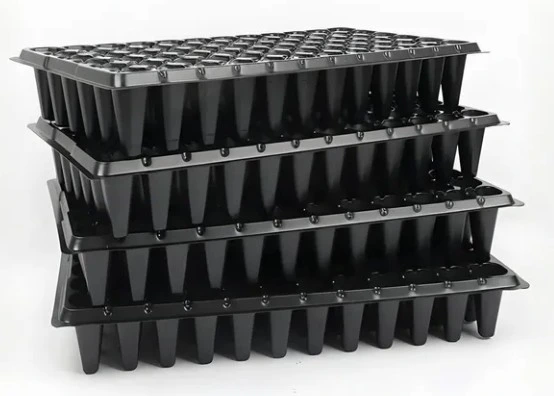
What is thermoforming?
Thermoforming consists of heating a rigid plastic sheet to its softening temperature, then forming it against a mold by vacuum suction, compressed-air pressure or mechanical action. After cooling, the part keeps the mold's shape.
The process is particularly suited to large-surface parts, open geometries and runs under 5,000 parts per year - where plastic injection would be economically disproportionate.
What CadNov brings
CadNov is not a thermoformer. We are your design office and integrator: we analyze your part's feasibility, write the specifications, select the right thermoformer from our network, and steer the trials through to validation.
We also step in upstream to help you choose between thermoforming and injection - a decision that can represent tens of thousands of euros of difference in tooling investment.
The thermoforming cycle - 5 phases
Heating
Plastic sheet heated uniformly to Tg (softening)
Forming
Sheet pressed against the mold: vacuum, pressure or mechanical tool
Cooling
Held against the mold until fully rigid
Cutting
CNC trimming or die cutting to obtain the finished part
Finishing
Drilling, assembly, painting, screen printing per specifications
5 thermoforming variants
Each configuration meets different requirements of geometry, precision and volume.
Vacuum forming
The basic process: air vacuum draws the hot sheet against the mold. Simple, economical, suited to large low-depth surfaces. Minimal tooling.
Pressure forming
Compressed air (3-8 bar) presses the sheet against the mold. Finely reproduces surface textures, sharp edges and fine details out of reach for simple vacuum.
Mechanical forming (plug assist)
A mechanical plug pre-stretches the sheet before vacuum or pressure. Achieves more uniform thickness in deep areas.
Twin sheet (double sheet)
Two sheets thermoformed simultaneously then welded around the edge to create a hollow double-wall part. Ideal for light structural parts or insulated containers.
In-line thermoforming (roll-fed)
Continuous process: the sheet is unwound, heated, formed, cut and stacked at the output. Very high output for food packaging.
Thermoforming: what you really need to know
Let's be direct. Thermoforming has real advantages - and limits that no one will tell you about unless you ask the right questions.
ADVANTAGES
Very low tooling cost
An aluminum or epoxy-resin mold costs €500 to 15,000. The same in plastic injection: €20,000 to 200,000. For runs under 5,000 parts/year, it's often the only economically viable process.
Short lead times
Tooling can be made in 2 to 6 weeks. Ideal for functional prototypes, pre-series and fast-evolving parts (design, ergonomics).
Large dimensions possible
Thermoforming routinely handles parts of 1,000 x 800 mm and beyond. In injection, above 600 mm, presses become very expensive.
Wide choice of materials and thicknesses
ABS, PC, PMMA, PETG, PP, PVC, HDPE, PEEK... From 0.5 mm to 15 mm. Tinted, textured or co-extruded sheets can be formed straight off the line.
Fast, low-cost modifications
Modifying a thermoforming mold is fast. In injection, the slightest steel rework can cost several thousand euros.
DRAWBACKS
Variable wall thickness
The sheet thins as it stretches in deep areas and corners. Unlike injection, thickness is not uniform - anticipate it from the design stage.
Lower dimensional accuracy than injection
Typical tolerances: +/-0.5 to +/-2 mm depending on process. Injection reaches +/-0.05 mm. Thermoforming is not suitable for tight-tolerance parts.
Significant material waste
The unformed sheet edges (offcuts) represent 15 to 40% of the material consumed depending on geometry. Recyclable but they raise the material cost per part.
Limited geometries
No undercuts without complex tooling. No closed parts (hollow bodies) except in twin sheet. Ribs and bosses cannot be made directly.
Higher part cost at high volume
Above 10,000 parts/year on a medium-sized part, injection becomes more competitive on part cost.
Thermoforming vs Plastic injection: choosing the right process
The choice isn't a matter of preference - it's a matter of numbers and technical constraints.
| Criterion | Thermoforming | Plastic injection |
|---|---|---|
| Tooling cost | €500 - 15,000 | €20,000 - 500,000 |
| Tooling lead time | 2 - 6 weeks | 8 - 20 weeks |
| Optimal volume | 100 - 10,000 parts/year | 1,000 - several million/year |
| Max part size | Up to 3,000 x 2,000 mm | Generally under 1,000 mm |
| Dimensional accuracy | +/-0.5 - 2 mm | +/-0.05 - 0.3 mm |
| Wall thickness | Variable (thinning) | Uniform and controlled |
| Ribs / bosses | No (unless machined after) | Yes, integrated in the mold |
| Hollow bodies | Twin sheet only | Blow molding only |
| Material waste | 15 - 40% (offcuts) | Under 5% (sprue) |
| Part cost at high volume | Higher | Optimized above 10,000/year |
| Tooling modifications | Fast and low-cost | Costly and slow |
Rule of thumb: part over 400 mm AND run under 5,000 parts/year → thermoforming. Outside this range, ask CadNov for a comparative analysis.
Plastic materials for thermoforming
The sheet choice determines the mechanical, thermal and aesthetic performance of the final part. CadNov advises you on the exact grade based on your requirements.
| Material | Strengths | Limits | Typical applications | Common thickness |
|---|---|---|---|---|
| ABS | Rigidity, surface finish, electroplatable, easy to paint | UV-sensitive without stabilizers, T max 80 C | Machine covers, panels, shells, prototypes | 2 - 6 mm |
| PETG | Transparency, ease of forming, good chemical resistance | Moisture-sensitive, T max 70 C | Displays, transparent guards, medical blisters | 0,5 - 4 mm |
| PC | Exceptional impact resistance, transparency, high T | Solvent-sensitive, high price | Visors, guards, portholes, safety parts | 1 - 8 mm |
| PMMA (Acrylic) | Crystal transparency, UV resistance, premium look | Brittle under impact, T max 80 C | Signage, panes, illuminated signs, cosmetics | 2 - 10 mm |
| HDPE | Chemical resistance, food-safe, flexible, economical | Dull surface finish, T max 80 C | Industrial bins, food bins, technical parts | 3 - 12 mm |
| PP | Light, impact-resistant, food-inert, living hinge | High shrinkage, delicate forming | Food packaging, bins, lids, medical parts | 1 - 6 mm |
| PVC | Economical, rigid transparent, easy to form | Fumes when heated, limited recyclability, REACH | Blisters, packaging, low-end technical parts | 0,3 - 3 mm |
| HIPS | Very good formability, economical, paintable | Brittle, T max 70 C, low chemical resistance | Cold food packaging, displays, decoration | 1 - 4 mm |
| PET / APET | Transparency, O2 barrier, food contact, recyclable | Narrow forming window, moisture-sensitive | Food trays, blisters, lids | 0,3 - 2 mm |
| PEEK | T up to 250 C, extreme chemical resistance, medical | Very high price, specialized forming | Aerospace, medical, high-temperature parts | 1 - 5 mm |
Fields of application
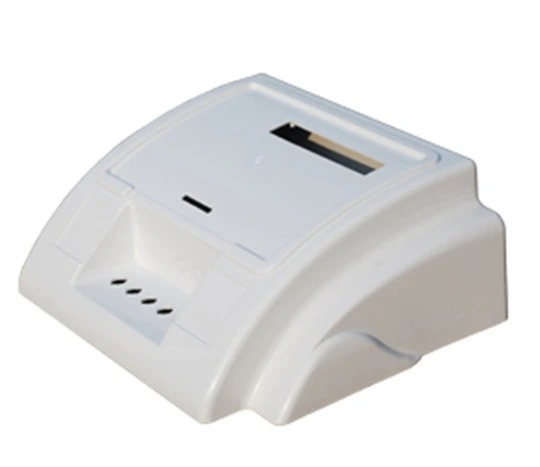
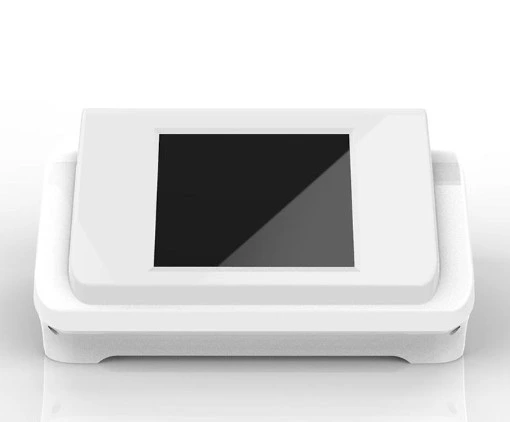
Thermoforming is present in every industrial sector - wherever size, lead times or volume make injection disproportionate.
Industry and Machinery
Protective covers, machine panels, industrial body panels, equipment shells. ABS and PC offer rigidity and a professional look.
Medical and Laboratory
Sterile blisters, laboratory trays, medical-equipment shells. Medical PETG and PC, ISO 10993 biocompatibility.
Food Packaging
Trays, lids, platters, blisters. In-line process for very high output. Food-contact PET, PP and APET.
Automotive and Transport
Interior trim, boot shelves, door panels, under-hood guards. ABS, ABS+PC and HDPE depending on thermal requirements.
Signage and Display
Signs, illuminated panels, road or industrial signaling enclosures. PMMA and PC for transparency, UV resistance and weather resistance.
Leisure and Sport
Kayak hulls, recreational-vehicle seats, protective equipment, sports accessories. HDPE, PP and impact ABS depending on mechanical loads.
Designing for thermoforming: the rules to follow
A part designed for injection will not thermoform correctly. Here are the specific rules that CadNov applies systematically.
Draft angles minimum 3 degrees
Unlike injection (1 degree is enough), thermoforming needs draft angles of at least 3 degrees for clean demolding - up to 5 degrees on rigid materials like PC.
Controlled depth / surface ratio
Forming depth must not exceed half of the smallest plan dimension. Beyond that, use plug assist to avoid excessive thinning.
Generous radii
Sharp edges create stress concentrations and zones of excessive thinning. Recommended minimum radius: 3 times the sheet thickness.
Plan the trimming upstream
The thermoformed part must be trimmed. The cut line must be defined right from the mold design - CNC, die cutting or laser depending on the required precision.
Our thermoforming approach
Before any tooling, CadNov performs a thermoforming-specific DFM analysis: draft angles, depth/surface ratio, radii, thinning zones, cut plan.
We calculate the starting sheet thickness needed to guarantee the minimum thickness at the bottom of the form - critical for the strength and conformity of the final part.
DFM analysis
Feasibility, draft angles, radii, critical zones
Material choice
Exact grade, sheet thickness, supplier
Tooling
Aluminum, resin or wood depending on volume and precision
Trials and validation
Dimensions, thickness, visual appearance, trimming
Innovation Tax Credit (CII)
CadNov is approved by the French Ministry (MESR). Design, prototype-tooling and thermoforming trial costs within an innovative project are eligible for the CII - up to 30% recovered.
A thermoforming project? Let's talk.
Free feasibility analysis within 48h - material, process, volume, indicative budget.
Submit my projectSee injection moldingAntoine ERRIGO · +33 (0)4 74 32 23 60 · direction@cadnov.fr · CadNov, 240 rue des Câbles de Lyon, 01000 Saint Denis Lès Bourg · CII-approved