Injection molding:
from material to production part
Since 1996, CadNov has steered your injection molding projects end to end - from material selection to series delivery, including tooling and trials. All technologies, all volumes.
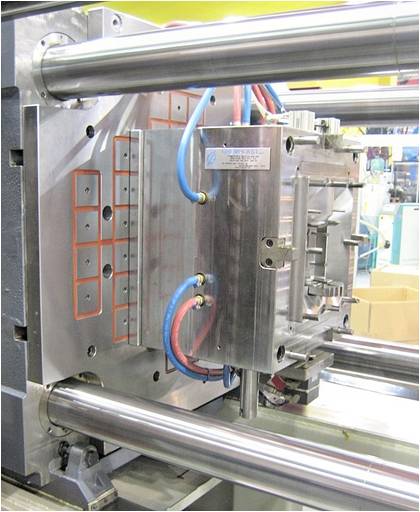
The injection molding process
Injection molding involves melting a thermoplastic material then injecting it under high pressure into the cavity of a closed mold. After cooling, the part is ejected with repeatable dimensional accuracy on the order of a hundredth of a millimeter.
It is the most widespread plastics processing method in the world: it covers parts from a few grams (connectors, caps) to several kilograms (automotive dashboards).
What CadNov brings
CadNov is not a molder. We are your integrator: we steer the entire chain - material selection, mold design, molder selection, trial monitoring and part qualification.
All our molding partners are ISO 9001 certified. Some hold IATF 16949 (automotive) or ISO 13485 (medical) certifications depending on your requirements.
The injection cycle - 5 phases
Plasticizing
Granules melted by the heated screw
Injection
Material forced into the cavity at high pressure (400-1600 bar)
Holding
Pressure held to compensate for material shrinkage
Cooling
Temperature-controlled mold - 60-80% of cycle time
Ejection
Mold opens, ejectors push out the part
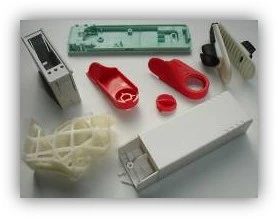
8 injection molding technologies
Every application has its optimal technology - from prototype to high-volume production, from a simple part to a hybrid component.
Standard injection
The basic process: one material, one mold, one part. Covers 80% of industrial applications. Cold runner or hot runner depending on volumes.
Two-shot / 2K injection
Two materials injected successively on a rotary press. Chemical or mechanical bond. No assembly, no gluing.
Overmolding
An already-molded part (substrate) is repositioned in a second mold and overmolded with a second material. Feasible on a standard press.
Insert molding
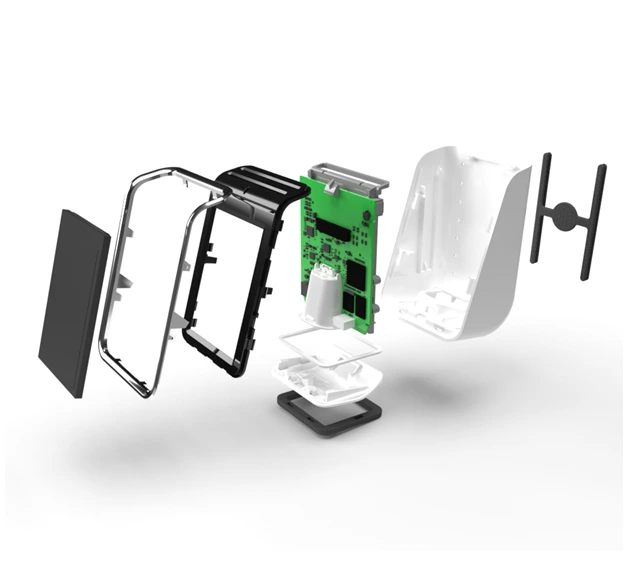
Inserts (metal, electronics) are placed in the mold before injection. The plastic material embeds and secures them. Higher strength than post-molding fastening.
LSR injection (liquid silicone)
Two-component (A+B) injection of liquid silicone into a cold mold. Heat vulcanization. Medical (ISO 10993) and food-grade (FDA) grades. Closed cycle, zero waste.
High-speed
Multi-cavity mold (up to 128 cavities), high-speed electric press, conformal cooling. Cycles under 5 seconds for very high volumes.
Thin wall
Wall thickness 0.3 - 0.8 mm. High-speed presses (over 500 mm/s), H13 mold with intensive cooling. High-flow PP and PE (MFI over 30 g/10 min).
Gas-assisted injection (GAIM)
Pressurized nitrogen is injected into the molten material to hollow out the core of thick areas. Eliminates sink marks and warpage on thick sections, lightens the part and reduces material and cycle time.
Choosing the right plastic material
Material choice determines performance, cost and mold feasibility. CadNov advises you based on your real functional requirements.
| Material | Key strengths | Typical applications | T max |
|---|---|---|---|
| PP | Lightweight, impact-resistant, economical, food-safe inert | Packaging, automotive, childcare, medical | 100 C |
| ABS | Rigidity + toughness, good surface finish, electroplatable | Electronic housings, toys, technical parts | 80 C |
| PA6 / PA66 | Mechanical strength, low friction, thermal resistance | Automotive, connectors, gears, under-hood parts | 130 C |
| PC | Optical transparency, impact resistance, fire resistance | Optics, car headlights, guards, medical | 120 C |
| POM | Low friction, rigidity, dimensional accuracy | Gears, slides, clips, plastic bearings | 110 C |
| PBT / PET | Thermal resistance, chemical resistance, good surface finish | Electrical connectors, housings, precision parts | 150 C |
| TPE / TPU | Flexibility + molded like a thermoplastic, recyclable | Seals, handles, overmolded skins, footwear | 80 C |
| PMMA | Crystal transparency, UV resistance, premium look | Optics, car lights, cosmetics, signage | 80 C |
| PA+GF30 | 2x rigidity, +20 C thermal resistance, creep resistance | Automotive structure, filled technical parts | 155 C |
| PEEK | Extreme thermal resistance, chemical resistance, biocompatible | Medical (implants), aerospace, oil/gas | 250 C |
| LSR silicone | Chemical inertness, biocompatibility, extreme temperatures, flexibility | Medical, food, high-performance seal | 200 C |
How CadNov chooses the material with you
We always start from the real functional requirements: service temperature, mechanical loads, chemical environment, regulations (REACH, RoHS, FDA, ISO 10993), appearance and finish. We compare 3 material candidates with grades, suppliers and indicative prices - so that you decide with full knowledge.
Fields of application
CadNov supports projects in demanding sectors since 1996 - each with its own standards, constraints and expectations.
Automotive
Body parts (bumpers, door panels), under-hood (connectors, manifolds), interior (dashboard, trim). IATF 16949 certification, PPAP required.
Cosmetics and Luxury
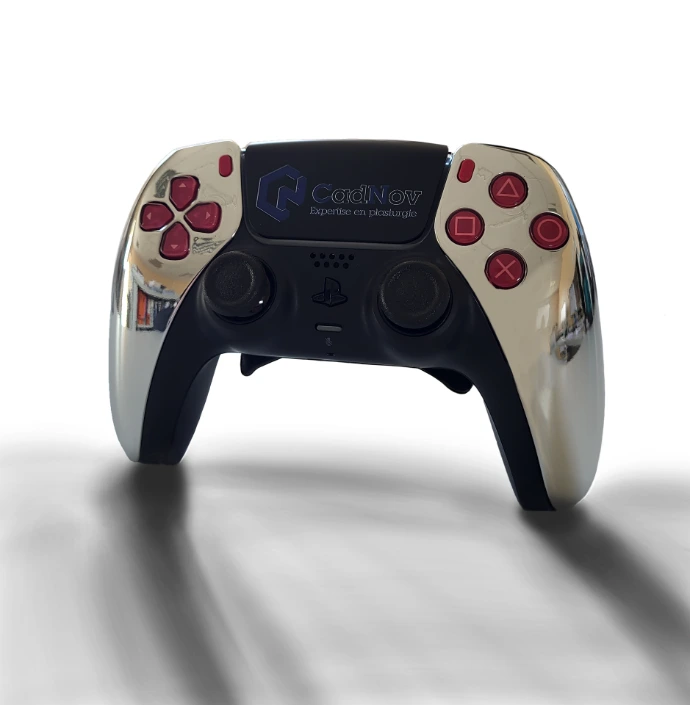
Bottles, caps, dispensers, applicators. Extreme surface-finish requirements - mirror polish, textured grain. Clients L'Oréal, Chanel, Bulgari in our portfolio.
Medical and Pharmaceutical
Medical devices, laboratory consumables. Material traceability, cleanroom, ISO 10993 biocompatibility, FDA if exporting to the US.
Toys and Childcare
CE safety, EN 71 compliance, phthalate- and BPA-free materials. Smoby in our portfolio - large dimensions, bright colors, strict aesthetic tolerances.
Electronics and Industry
Housings, connectors, DIN rails, covers. UL94-V0 fire resistance often required. Dimensional accuracy for automated assembly.
Packaging
Caps, dispensers, bottles, seals, boxes. Very high volumes - high-speed molding essential. Food-contact materials: PP, PE, PET depending on migration.
The costly mistakes we save you from
Injection molding is demanding. Problems appear early and cost dearly if they aren't anticipated.
Wrong material choice
A material that's too generic (standard PP where impact-modified PP is needed) causes breakages in production. CadNov specifies the exact grade, not just the family.
Insufficient draft angles
A part without a correctly calculated draft angle won't eject, or gets marked. DFM is done before the first cut of the mill.
Unanticipated shrinkage
Every material has its shrinkage rate (0.5% to 2%). Without simulation, final dimensions drift. CADMOULD calculates deformations before tooling.
Poorly positioned injection gate
A poorly placed gate causes visible weld lines, sink marks or unbalanced filling. Upstream rheological simulation avoids these defects.
Our answer: systematic DFM analysis
Before validating any mold drawing, CadNov performs a complete DFM (Design for Manufacturability) analysis. We check draft angles, wall thicknesses, the parting line, risk areas.
Rheological simulation (CADMOULD Rapid) validates filling, weld lines, warpage and optimal gate positions - before the mold is made.
Innovation Tax Credit (CII)
CadNov is approved by the French Ministry (MESR). Simulation, design and injection-trial costs within an innovative project are eligible for the CII - up to 30% recovered.
Our injection molding approach
From your idea to the part in production - CadNov steers every step.
Needs analysis
Functional requirements, material, volume, lead time, budget
DFM + simulation
Part check, rheological simulation, material selection
Tooling
Mold specifications, toolmaker selection, manufacturing follow-up
T0/T1/T2 trials
Part validation, parameter tuning, dimensional measurements
Series production
Transfer to molder, control plan, delivery
An injection molding project? Let's talk.
Free feasibility analysis within 48h - material, process, volume, budget.
Submit my projectOur injection moldsAntoine ERRIGO · +33 (0)4 74 32 23 60 · direction@cadnov.fr · CadNov, 240 rue des Câbles de Lyon, 01000 Saint Denis Lès Bourg · CII-approved